Quarterly Essay 20 A Time for War by John Birmingham
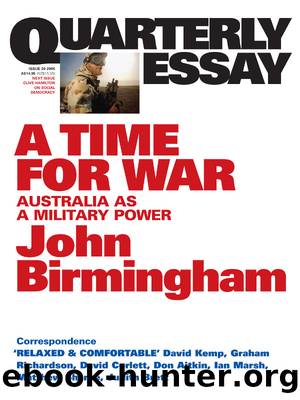
Author:John Birmingham [Birmingham, John]
Language: eng
Format: epub
Tags: History, Australia & New Zealand, Military, Afghan War (2001-)
ISBN: 9781921825194
Google: xtBO6WbFOIIC
Publisher: Black Inc.
Published: 2005-12-01T03:16:35+00:00
RELAXED AND
COMFORTABLE
Correspondence
David Kemp
Judith Brett has once more shown herself to be one of the foremost commentators on the Liberal Partyâs political role. It is really the fact that her essay is so good that has prompted my response, because it would be too easy to take Relaxed and Comfortable as an assessment of the Howard years, which it is not. There are important aspects of the Howard record that are omitted or, I believe, misinterpreted, and it seemed useful, perhaps, to put some of these on the table for future discussion.
Brett herself is quite explicit about her purpose. Her essay, she says, is basically directed at the left, and aims to defend the Australian people from unfair charges levelled against them from the left because of their support at several elections for the Howard government. Part of her defence of the electorate is that the Howard government is much more in the mainstream of the Australian Liberal tradition than its critics from the left are often willing to concede. In this I agree with her, and welcome her sensible decision to recognise that there is such a Liberal tradition, and that it simply will not do in this day and age to keep talking about ânon-labourâ parties, as if the parties so characterised were not as central to the Australian political tradition as Labor.
Brett is clearly correct in her general assessment that the Liberal Party and the political tradition it represents has long seen itself as representing the national interest over sectional interests. This was the stated position of the first Federal Liberal Party formed after the Fusion of 1910, and it has been a consistent theme ever since. Indeed, Brett undervalues the importance of the Liberal organisations and liberal thought of nineteenth-century politics â the organisations and ideas that produced the Australian Federation.
Yet, not surprisingly, the article still carries intellectual baggage from the left, and I thought it would be useful to identify some of this baggage as a contribution to pushing along the debate about the Liberal Partyâs role in the national life.
First, at the risk of seeming to niggle, there are times when Brett seems unwilling to concede active agency to the Liberal Party in influencing national life for the good â when good outcomes happen, it is not Liberal policies that are responsible. When Australia prospers under the Menzies government, her comment is that âhistory has been kind to the Liberal Partyâ, not that Menziesâ policies contributed to prosperity. Or that his education policies expanding the university system were a key factor in the rise of the ânew classâ of the tertiary-educated, or that his school policies helped to bring an end to sectarianism. Horneâs comment from The Lucky Country is to the same effect â that âlittle of what [Menzies] did seems to matter much â¦â
It hardly needs saying that a completely different interpretation is not only possible, but also more plausible â that Menziesâ reassertion of an economic system based around private enterprise and limited government was absolutely key to the Australian experience after 1949.
Download
This site does not store any files on its server. We only index and link to content provided by other sites. Please contact the content providers to delete copyright contents if any and email us, we'll remove relevant links or contents immediately.
The Vikings: Conquering England, France, and Ireland by Wernick Robert(84379)
Ali Pasha, Lion of Ioannina by Eugenia Russell & Eugenia Russell(40318)
The Conquerors (The Winning of America Series Book 3) by Eckert Allan W(37983)
The Vikings: Discoverers of a New World by Wernick Robert(37006)
Cecilia; Or, Memoirs of an Heiress — Volume 1 by Fanny Burney(32636)
Cecilia; Or, Memoirs of an Heiress — Volume 2 by Fanny Burney(32010)
Cecilia; Or, Memoirs of an Heiress — Volume 3 by Fanny Burney(31996)
Empire of the Sikhs by Patwant Singh(23135)
The Secret History by Donna Tartt(19294)
Hans Sturm: A Soldier's Odyssey on the Eastern Front by Gordon Williamson(18649)
Cat's cradle by Kurt Vonnegut(15441)
Pimp by Iceberg Slim(14665)
Sapiens: A Brief History of Humankind by Yuval Noah Harari(14460)
Norse Mythology by Gaiman Neil(13457)
Talking to Strangers by Malcolm Gladwell(13439)
Leonardo da Vinci by Walter Isaacson(13411)
4 3 2 1: A Novel by Paul Auster(12511)
Underground: A Human History of the Worlds Beneath Our Feet by Will Hunt(12145)
The Radium Girls by Kate Moore(12093)
